
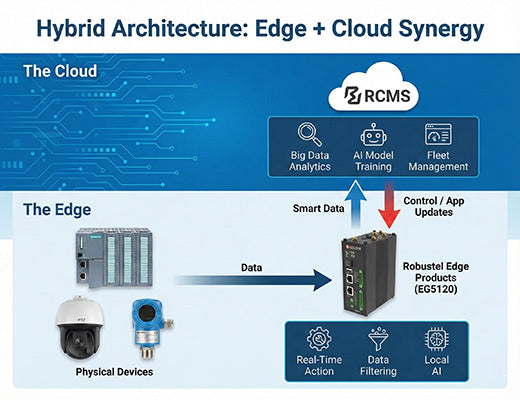
Summary
The debate over edge products vs cloud computing is central to modern IoT. A "cloud-only" model, where all data is sent to a central server, is failing due to high costs, slow response times (latency), and major security risks. This guide explains why local processing on smart edge products (like industrial routers and gateways) is now a non-negotiable. We'll show how intelligent edge computing products are essential for filtering data, enabling real-time decisions, and providing reliability when the internet fails.
Key Takeaways
Cloud-Only is Flawed: Relying only on cloud computing is slow (high latency), expensive (high bandwidth/storage costs), and unreliable (fails if the internet drops).
Edge Products Solve This: An industrial edge product is a small, powerful computer that sits with your machines. Its job is to process data locally.
Key Benefits: Local processing on edge products provides 1) Millisecond Latency (for real-time action), 2) Massive TCO Savings (by filtering "data noise" and slashing cellular costs), and 3) Offline Operation (it keeps working if the WAN fails).
It's a Partnership: The future isn't "Edge vs. Cloud." It's a hybrid: edge products handle real-time tasks locally, and the cloud handles big-data analytics and fleet management.
Edge Products vs. Cloud Computing: Why Local Processing is a Must
For the last decade, "the cloud" was the answer to everything. The model was simple: connect all your devices with "dumb" pipes and stream the "data firehose" to a massive, centralized server on AWS or Azure. Let the cloud's infinite power sort it out.
This "cloud-only" model is now officially broken.
I've seen projects with 1,000 remote sensors fail because their 4G/5G data bills were $50,000 a month. I've seen factory automation plans stall because the 2-second round-trip to the cloud was too slow for a safety-critical robot.
The future is not about replacing the cloud. It's about fixing this broken model. The solution is to put intelligence where the data is created: at the "edge." And the tools to do this are edge products.
The "Cloud-Only" Model: Why It's Failing
edge products, you must understand the three critical failures of a "cloud-only" architecture.1. The "Speed of Light" Problem (Latency)
- The Problem: You have a machine. A sensor detects a critical failure. In a cloud-only model, the data has to travel 1,000 miles to a server, get processed, and then a "STOP" command has to travel 1,000 miles back. This round-trip can take 2-5 seconds.
- The Impact: In a factory, 2 seconds is an eternity. The machine has already crashed. For a real-time application, you cannot defy physics. A high-latency cloud link is useless for real-time control.
2. The "Data Firehose" Problem (Bandwidth & Cost)
-
The Problem: A single factory camera running AI quality-control can generate terabytes of data a day. A
cellular edge routeris the only way to connect it, but you can't afford to send that much data over a 5G plan. -
The Impact: Your TCO (Total Cost of Ownership) is astronomical. You're paying millions to stream "data noise"—like 8 hours of a machine running perfectly—just to find the 2 seconds of anomaly data. These
edge productssolve this.
3. The "All Your Eggs in One Basket" Problem (Reliability & Security)
- The Problem: What happens when the internet connection to your factory goes down?
- The Impact: Your "cloud-only" system stops dead. Your "smart" factory becomes a "dumb" one. Furthermore, sending all your raw, sensitive operational data to the cloud creates a massive security attack surface.

The "Smart Edge" Solution: How Edge Products Fix This
A modern industrial edge product is not just a "dumb pipe" router. It is an edge computing gateway—a powerful, rugged computer that lives at the edge.
This edge product has a new job: Don't just send data, process it. This local processing capability solves all three problems.
1. Solving Latency (The 10-Millisecond Decision)
With edge products, the "brain" is local.
- The Solution: A smart edge product (like the EG5120 ) runs the "STOP" logic on the device itself.
-
The Result: Sensor detects failure. The edge product's CPU detects the anomaly locally. It triggers a local relay locally. The total time is 10 milliseconds. This is the power of
local processingon a "smart" edge router.
2. Solving Data Costs (The "Data Filter")
A smart edge product is a "data filter," not a "data firehose."
-
The Solution: The
edge computing gatewayruns a local analytics script. It watches the 1,000 data points per second. -
The Result: It only sends a single message to the cloud:
{"alert": "Anomaly_Detected", "timestamp": "..."}. You've just reduced your data bill by 99.9%. Your edge product just paid for itself in one month.
3. Solving Reliability & Security (The "Offline Brain")
- The Solution: The internet connection fails. The edge product doesn't care. It keeps running its local logic, controlling the machine and buffering critical data to its onboard eMMC storage. When the connection returns, it safely uploads the summary.
-
Security: Sensitive raw data never leaves the edge product or the factory floor. This dramatically improves your
ot securityposture.
This is Not a "Cloud vs. Edge" Fight; It's a Partnership
This is the most important concept. The edge products vs cloud computing debate isn't about choosing one. It's about creating a powerful hybrid system.
-
The
Edge Product's Job (Real-Time & Local):- Run real-time safety and control loops.
- Filter and aggregate "noisy" raw data.
- Run local AI models (e.g., on an NPU-equipped
edge router). - Encrypt and secure all data from the "soft" OT network.
-
The Cloud's Job (Big Data & Global):
- Receive processed insights from its fleet of edge products.
- Perform long-term, big-data analytics.
- Train new AI models to be pushed down to the edge products.
- Manage the entire fleet of edge products (via a platform like RCMS ).
Your edge products are your "local managers" in the field. The Cloud is the "corporate HQ" they report to.

How to Choose Edge Products for Local Processing
If you agree that local processing is a must, you can no longer buy a simple "modem" or "router." You must buy a true edge computing gateway.
When evaluating edge computing products, look for these two things:
- Powerful Hardware: It needs a multi-core CPU, ample RAM (1-2GB+), and (for AI) a dedicated NPU. A basic edge router with a single-core MIPS CPU cannot do this.
-
An Open OS: This is the key. You must avoid a "black box" device. You need an
open os edge productthat runs a standard OS like Debian and supports Docker. This Docker-on-an-edge-router capability is what gives your developers the freedom to deploy any application.
These "smart" edge products are the new standard for any industrial edge product deployment.
Conclusion
The "cloud-only" model is obsolete. It's too slow, too expensive, and too unreliable for the demands of modern industry.
The edge products vs cloud computing debate is over: you need both. A hybrid model is the only path forward. Local processing is no longer optional; it is an economic and operational must.
Your edge products are this new, critical layer of intelligence. By choosing a powerful industrial edge product that can run real applications (Docker, AI, local analytics), you are building a faster, cheaper, and more reliable system than any "cloud-only" architecture could ever be.

Frequently Asked Questions (FAQ)
Q1: What is the main difference between edge products and cloud computing?
A1: Location. Cloud computing happens in a large, centralized data center, far away from your devices. Edge products (like an edge router or IoT Gateway) perform computing at the physical location of your devices (the "edge" of the network), enabling faster, cheaper, and more reliable local processing.
Q2: Can edge products work without a cloud connection?
A2: Yes, and that's a key feature. A "smart" edge product can run its local applications (like machine control or data filtering) independently of the cloud. This means your factory can keep running even if the internet connection goes down, which is a massive win for reliability.
Q3: Is an IoT Gateway one of the edge products?
A3: Yes. An IoT Gateway is one of the most common and important types of edge products. A "basic" IoT Gateway just translates protocols. A "smart" IoT Gateway (or edge computing gateway) does that plus all the powerful local processing we've discussed, making it one of the most valuable edge products you can buy.


Comments
Leave a comment