
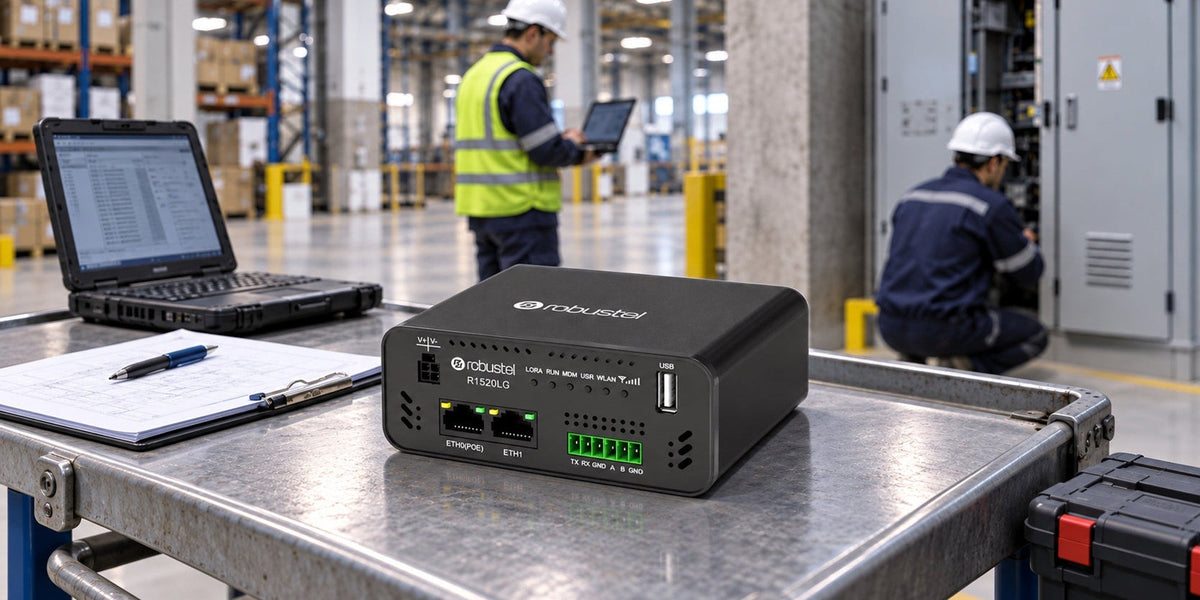
Private LoRaWAN deployments are delayed when teams arrive with an incomplete software baseline, missing sensor information or no agreed evidence that data reached the intended application. For a Robustel R1520LG LoRaWAN gateway project, resolve these dependencies in order: gateway access, selected network-server path, sensor configuration, activation and application verification. The commissioning mistakes below are preventable gaps drawn from that documented workflow, not a ranking of observed failure rates. A staged evidence record helps identify the first unresolved dependency without repeatedly rebuilding the entire setup.

Illustrative preparation for a private LoRaWAN commissioning visit.
Key Takeaways
- Confirm whether the gateway already has the intended embedded software before following installation instructions.
- Prepare sensor identity and configuration information before scheduling activation tests.
- Keep activation, uplink reception and application verification as separate acceptance steps.
- Resolve one observed dependency at a time and retain the before-and-after evidence.
In This Guide
- Which dependencies should be ready before site work?
- Which mistakes create unnecessary rework?
- How should a blocked deployment be investigated?
- Frequently asked questions
Which dependencies should be ready before site work?
Make a short readiness record for the exact gateway and representative sensor that will be tested. It should identify the person who can provide each missing item, not merely mark an item as “pending.” A site visit should begin with a testable configuration and an accessible decision owner.
| Dependency | Evidence to prepare | Consequence if missing |
|---|---|---|
| Gateway baseline | Model, firmware, selected software path and authorised access method | Instructions may be applied to the wrong starting state |
| Sensor information | Model, identifier, activation method and manufacturer configuration | The intended device cannot be confidently registered |
| Radio configuration | Reviewed region and relevant channel settings | Activation tests lack a verified common configuration |
| Upstream service | Intended server or application endpoint and responsible owner | Local success cannot be traced to the final destination |
| Acceptance record | Expected sample, source identity and application observation | Teams disagree over what “working” means |
This is a dependency list rather than a complete installation checklist. Use the R1520LG hardware documentation for the gateway's physical installation requirements. Here, the objective is to prevent an engineer from spending a visit waiting for information another team controls.
Which mistakes create unnecessary rework?
Is the installation guide being applied to the wrong starting state?
Robustel's R1520LG private-network guide distinguishes an existing embedded ChirpStack environment from manual installation or custom configuration. Record the software already installed and the desired end state before using a procedure.
Do not make “reinstall everything” the first response to a missing sensor reading. Compare the current baseline with the intended workflow and preserve the original observations. If an update is required, assign it a change record with a reason and a validation plan.
Are sensor details spread across emails and labels?
Prepare one controlled device record that links the physical sensor to its registered identity and configuration. Store secret credentials in the authorised credential system; the commissioning checklist should reference their availability without duplicating them in screenshots or shared work notes.
The official local activation procedure identifies required device parameters and provides separate activation and transmission checks. Use its fields to validate completeness. If two teams use different names for the same physical sensor, agree on a stable asset identifier before interpreting results.
Has the team confused a joined sensor with a completed application?
Give each stage its own evidence field. Record whether activation was observed, whether a new uplink arrived, and whether the expected application displayed a correctly identified value. The first two checks belong to the gateway/network workflow; the last belongs to the application acceptance record.
For a project-specific example, choose a sensor value whose meaning can be independently checked during commissioning. Record the sensor identity, observation time, received representation and displayed result. Set the acceptable timing and value checks with the application owner. A screenshot of a populated dashboard without those references cannot establish which test it represents.
Were several changes made before the original symptom was captured?
Changing credentials, radio settings, firmware and application configuration together makes the result difficult to explain. Record the starting symptom, the evidence that points to a specific dependency, the proposed change and the verification that will follow. This discipline makes a successful repair reusable and an unsuccessful change reversible by the responsible engineer.

Illustrative commissioning review linking a physical device to its recorded test.
How should a blocked deployment be investigated?
Find the first stage with missing or contradictory evidence. If authorised gateway access is unavailable, resolve that before investigating application values. If the gateway is accessible but the selected network-server workflow is uncertain, identify the software baseline. If a sensor is registered but activation is absent, compare the recorded identity and radio configuration with the guide.
Once an uplink is visible, hand the evidence to the person responsible for decoding and delivery. Include the timestamp and device identity so that person can follow the same event. Do not ask the application owner to diagnose “no data” without specifying where data was last observed.
Before applying a firmware change, check the R1520LG firmware page and the relevant release notes. The existence of a newer download does not, by itself, explain the observed symptom. Use the R1520LG software manual entry to reach the supported operating documentation for the actual product.
Close a blocker only when the test that exposed it passes and the resulting baseline is recorded. Document residual limitations separately so that commissioning completion does not silently become an untested production promise.
Frequently asked questions about commissioning delays
Should we reinstall ChirpStack when a sensor does not appear?
First establish the existing software state and the first failing verification step. An installation procedure and an end-device activation procedure address different starting conditions; select the one supported by the evidence.
What should be ready before the sensor supplier leaves site?
Agree on the physical asset identity, configuration information, approved credential handoff and a repeatable way to generate a test observation. Keep a named contact for unresolved device-specific questions.
Can successful activation be the only acceptance criterion?
It can close an activation test, but it does not close the application test. Define separate evidence for the value and identity seen by the intended receiving application.
How should we report a blocker to Robustel support?
Provide the product and software baseline, the last successful stage, a timestamped symptom, relevant sanitised evidence and the changes already attempted. Exclude credentials and unrelated production data from the support record.
What should the next commissioning visit achieve?
Prepare a dependency record with one owner for every open item and one verification step for every proposed change. Use the R1520LG documentation hub to confirm the applicable instructions, and plan the visit around closing specific evidence gaps rather than repeating the whole deployment.
About the Author
Mark, Technical Support Engineer at Robustel
Mark is a Technical Support Engineer at Robustel with hands-on experience in industrial networking and edge connectivity. He helps customers plan, deploy, configure, and troubleshoot industrial IoT solutions, including cellular routers, edge gateways, and LoRaWAN systems. His work spans technical support, product training, configuration review, and practical deployment guidance for reliable and repeatable field operations across global projects and long-term operational support.
Comments
Leave a comment