
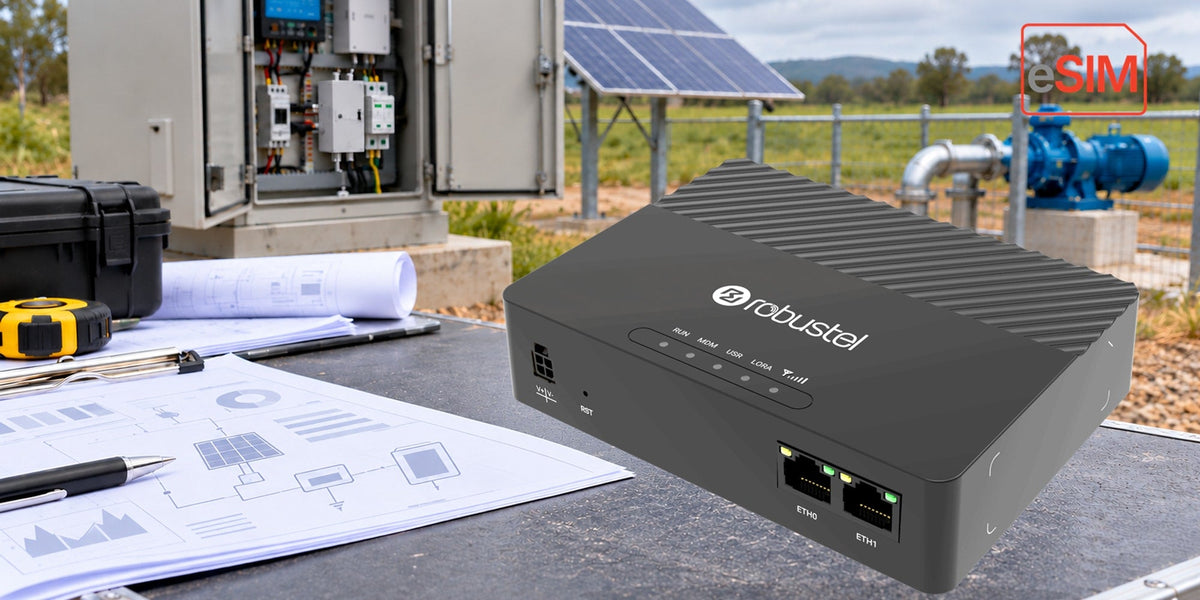
Design a reliable power path before the gateway reaches a pole, roof, or remote enclosure. This guide explains how to turn the topic into a repeatable industrial deployment, using the Robustel R1320LGe as the corresponding product reference.

Key Takeaways
- Begin with a measurable operational outcome and acceptance threshold.
- Treat power-source capacity, PoE distance and loss, and grounding boundaries as connected design decisions.
- Use a controlled R1320LGe baseline and keep site-specific settings documented.
- Test failure and recovery behavior, not only normal operation.
In This Guide
- Start with the operational decision
- Plan power-source capacity
- Control PoE distance and loss and grounding boundaries
- Build around the R1320LGe
- Validate surge exposure
- Operationalize backup-power testing
- How Should You Turn This Topic into an Engineering Worksheet?
- Review the Corresponding Product in Context
- What Should the Final Acceptance Record Contain?
- What Should Be Checked Before Handover?
- What Should You Do Next?
- Frequently Asked Questions
Start with the operational decision
A useful lorawan gateway power supply plan begins with the decision the system must support, not with a list of features. Design a reliable power path before the gateway reaches a pole, roof, or remote enclosure. Define who acts on the data, the acceptable delay, the consequence of missing an update, and the evidence needed at acceptance. This keeps the project tied to business and operational outcomes.
Document the normal state, degraded state, and recovery state. When those states are clear, teams can choose polling intervals, reporting rules, alarms, security controls, and support ownership without relying on assumptions.
Plan power-source capacity
power-source capacity should be treated as a design input and an acceptance item. Record the source data, expected range, limiting conditions, and owner. Do not copy a value from a laboratory test into a production plan without checking the real site, traffic pattern, power environment, and maintenance process.
Set a measurable target and a failure threshold. A target describes normal performance; a threshold tells the team when to investigate, isolate, or roll back. Both should appear in the commissioning record.
Control PoE distance and loss and grounding boundaries
PoE distance and loss and grounding boundaries often interact. A change that improves one can create load, latency, power, security, or support consequences elsewhere. Review them together and make the trade-off visible to operations, IT, and the system integrator.
Use a small pilot that reflects the hardest expected condition. Capture timestamps, retries, resource use, signal or network quality, and operator observations. The purpose is to learn which assumptions are safe before repeating the design across sites.
Build around the R1320LGe
Use the Robustel R1320LGe as the named gateway for this deployment pattern, while confirming the exact regional variant, interfaces, software options, and certifications against the current product page and datasheet. The gateway should be configured from a controlled template, with site-specific values kept separate from the standard baseline.
Keep the official device identity, configuration backup, firmware or application version, network settings, and support contact in the asset record. This makes replacement and troubleshooting faster and prevents undocumented one-off configurations.
Validate surge exposure
surge exposure must be verified under realistic load and failure conditions. Test normal service, loss of upstream connectivity, power interruption, delayed responses, and recovery after the fault is removed. A system that works only in the happy path is not ready for unattended industrial operation.
Record the test method, time, result, and evidence location. Where possible, repeat the same test after configuration, firmware, carrier, application, or infrastructure changes.
Operationalize backup-power testing
backup-power testing turns a technical installation into a maintainable service. Assign ownership for monitoring, credentials, updates, backups, certificates, data quality, and escalation. Define what can be changed remotely and what requires site approval.
Review the baseline after the first week and first month of operation. Real traffic and environmental data will expose limits that a short commissioning window cannot show.
How Should You Turn This Topic into an Engineering Worksheet?
A useful guide must connect the design question to values that can be reviewed and tested. For this R1320LGe deployment pattern, record the following inputs before configuration begins:
- Normal and peak gateway power draw
- PoE source class and cable length
- DC voltage drop and connector loss
- Earth and bonding arrangement
- Surge exposure on power, Ethernet, and antenna paths
- Backup runtime and restart behavior
Worked planning example
For a long copper run, calculate voltage or PoE power at the gateway after cable loss instead of checking only the injector rating. Add the gateway, modem peaks, heater or accessory loads where applicable, and a design reserve. Commission with a measured value at the installed endpoint, then repeat startup and cellular attach while the supply is at its lowest expected voltage.
Acceptance matrix
| Acceptance item | Pass condition | Evidence |
|---|---|---|
| Endpoint power | Above the documented minimum during startup | Measured voltage/power trace |
| Protective path | Power, Ethernet, and antenna protection reviewed | Installation drawing and photos |
| Backup runtime | Meets the outage requirement under representative load | Timed power-loss test |
| Recovery | Gateway reconnects without manual intervention | Event and connectivity logs |
Use project-specific product documentation for the exact orderable variant and software release. Values in the worksheet are design inputs or test examples; they should not be interpreted as undocumented product specifications.
Review the Corresponding Product in Context

The R1320LGe is the product reference for this article, not a substitute for requirements review. Match the exact orderable variant to the deployment country, interfaces, software path, environmental conditions, workload, accessories, and lifecycle expectations. Where a capability is mandatory, retain the applicable product document and the result of a representative test.
What Should the Final Acceptance Record Contain?
The final record should make the result reproducible. Include the approved input values, exact product variant, configuration or mapping version, representative test equipment, timestamps, pass/fail decision, unresolved exceptions, and the person responsible for follow-up.
| Acceptance item | Pass condition | Evidence to retain |
|---|---|---|
| Endpoint power | Above the documented minimum during startup | Measured voltage/power trace |
| Protective path | Power, Ethernet, and antenna protection reviewed | Installation drawing and photos |
| Backup runtime | Meets the outage requirement under representative load | Timed power-loss test |
| Recovery | Gateway reconnects without manual intervention | Event and connectivity logs |
What Should Be Checked Before Handover?
- Confirm the exact R1320LGe variant, interfaces, region, software path, accessories, and installation limits against current official documents.
- Complete every design input in the engineering worksheet; mark unknowns as open requirements.
- Run the representative normal, peak, disconnected, restart, and recovery tests.
- Save configuration, mapping, version, test data, screenshots or logs, and exception decisions in the project record.
- Assign owners for monitoring, credentials, updates, backup, incident response, and replacement.
- Schedule a post-commissioning review using real operating data.
Review Robustel R1320LGe and related gateway options before final selection. Confirm current specifications for the exact orderable variant.
What Should You Do Next?
Take one planned R1320LGe deployment and write a single end-to-end acceptance statement for lorawan gateway power supply. Identify the source, gateway action, destination, normal timing, failure response, and accountable owner. Then test that statement with representative equipment and retain the evidence with the site record. Use the relevant Robustel product page and support documentation to resolve any model- or software-specific uncertainty before rollout.
Frequently Asked Questions
Is the R1320LGe the only possible gateway for this design?
No. It is the corresponding listed product for this guide. Final selection should follow the required interfaces, regional approvals, environmental limits, application workload, and lifecycle policy.
What should be tested before a global rollout?
Test the most demanding site profile, including peak traffic, weak or lost upstream connectivity, power interruption, configuration restoration, alarm delivery, and the recovery procedure.
How should teams prevent configuration drift?
Maintain a versioned baseline, separate standard settings from site variables, restrict change access, and compare deployed configurations during scheduled reviews.
What evidence should be included at handover?
Include the asset record, approved design, configuration backup, software versions, test results, network and security ownership, alarm routing, support contacts, and recovery instructions.
About the Author
Sofia Martinez
Sofia Martinez is a Technical Content Engineer at Robustel with practical knowledge of industrial networking and edge connectivity. She helps customers translate technical requirements into workable industrial IoT deployments using cellular routers, edge gateways, and LoRaWAN systems. Her work spans technical content, product configuration, deployment preparation, and troubleshooting guidance for consistent and dependable operations across global sites.
Comments
Leave a comment