
Summary
If you search for "5G connectivity device," you will be bombarded with terms: Modem, Router, Gateway, CPE. Vendors often use these words interchangeably, creating confusion. However, technically, they are distinct devices with different roles. This guide clears the fog. We explain that a Modem is a simple connector (the "Mouth"), a Router is a network manager (the "Brain"), and a Gateway is a protocol translator (the "Diplomat"). We also discuss how modern industrial hardware is converging these functions into single, powerful units.
Key Takeaways
The Modem: It strictly handles the radio signal. It connects one device to the internet. It has no security or networking smarts.
The Router: It manages a local network (LAN), assigns IP addresses, and provides security (Firewall). It connects many devices.
The Gateway: In an IoT context, it does everything a router does plus translates data languages (e.g., converting Modbus to MQTT).1
The CPE: A telecom term ("Customer Premises Equipment") that refers to whatever box the internet provider puts in your office, regardless of its technical function.
5G Gateway vs. 5G Router vs. 5G Modem: What’s the Difference?
You are ready to deploy 5G in your business. You open a catalog and see three different boxes:
- Industrial 5G Modem ($)
- Industrial 5G Router ($$)
- Industrial 5G Gateway ($$$)
They all look like metal boxes with antennas. They all take a SIM card. So, what is the difference?
Choosing the wrong one is a common and costly mistake. Buy a modem when you need a router, and your staff won't be able to connect. Buy a router when you need a gateway, and your factory machines won't talk to the cloud.
Let’s break down the terminology using simple analogies.

1. The 5G Modem (The "Mouth and Ears")
The Modem (Modulator-Demodulator) is the most basic component.
Its job is purely physical: it converts radio waves from the air into digital bits for a computer.
- The Analogy: Think of a modem as a Telephone Handset. It allows you to speak and hear, but it doesn't decide who to call or what to say.
- Capabilities: It connects to the cellular tower. That’s it.
- Connectivity: It usually has a USB or Serial port to connect to one computer (or one router). It does not have Wi-Fi. It does not run a firewall.
- Who Needs It: An engineer building a custom robot who already has a powerful computer inside and just needs a "dumb pipe" to the internet.
2. The 5G Router (The "Traffic Cop")
A Router is a networking device.
It takes the internet connection (from the modem inside it) and shares it with multiple devices.
- The Analogy: Think of a router as a Traffic Cop. It directs data packets to the right place. "You go to the Laptop," "You go to the Printer."
-
Capabilities:
- DHCP: Assigns local IP addresses to devices.2
- NAT: Allows 50 devices to share one public IP address.
- Security: Built-in Firewall and VPN capabilities.
- Who Needs It: A branch office, a retail store, or a bus. If you need to connect laptops, cameras, and phones to the internet securely, you need a router.
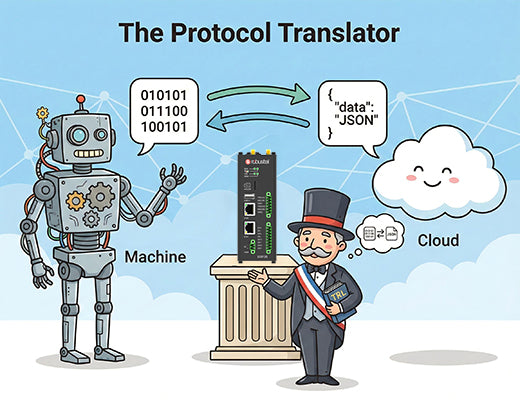
3. The 5G Gateway (The "Diplomat")
In the world of IT (Information Technology), "Gateway" and "Router" are often synonyms.
But in the world of IoT (Internet of Things) and Industry, a Gateway is something more.
A Gateway is a router that also performs Translation.
- The Analogy: Think of a gateway as a Diplomat. It not only delivers the message but translates it so the receiver understands.
-
Capabilities:
- Protocol Conversion: It reads data from a legacy machine speaking "Modbus" (an old industrial language) and converts it to "MQTT" or "JSON" (modern cloud languages).3
- Edge Computing: It can process data locally (e.g., "Filter out normal temperature readings, only send alerts").
- Who Needs It: A smart factory, a utility company, or any project connecting "dumb" non-IP machinery to the cloud.

4. What about "CPE"?
You will often hear 5G carriers (like Verizon or T-Mobile) talk about 5G CPE.
CPE stands for Customer Premises Equipment.4
This is not a technical function; it is a location term. It simply means "The box we put in your building."
- If the carrier gives you a box that acts as a modem, router, and Wi-Fi access point, they call it a CPE.
- Technically, a CPE is almost always a 5G Gateway.
5. The Convergence: All-in-One Devices
Here is the confusing part: Modern industrial hardware is evolving.
High-end devices (like the Robustel R5020) are technically all three.
- It has a Modem chip inside to talk to 5G towers.
- It runs Routing software (RobustOS) to manage IP traffic and VPNs.
- It has Gateway smarts (smart applications) to translate industrial protocols.
Buying Guide: Which one do I choose?
Feature |
5G Modem |
5G Router |
5G Gateway |
Primary Job |
Signal Conversion |
Network Management |
Protocol Translation |
Simultaneous Users |
1 (Direct connection) |
Many (via Wi-Fi/LAN) |
Many (via Wi-Fi/LAN) |
Security (VPN/Firewall) |
None (Relies on Host) |
High |
High |
Smart Processing |
None |
Limited |
Advanced (Edge Computing) |
Best For... |
Custom Engineering Integration |
Offices, Retail, Vehicles |
Factories, IoT, Smart Cities |

Conclusion: Use Case Dictates Hardware
Don't get hung up on the labels on the box. Look at the features you need.
- Need to give Wi-Fi to passengers on a bus? Buy a 5G Router.
- Need to connect a 1990s CNC machine to Azure Cloud? Buy a 5G Gateway.
- Building a custom drone circuit board? Buy a 5G Modem module.
In the modern industrial landscape, the 5G Gateway is usually the safest bet. It provides the connectivity of a modem, the security of a router, and the intelligence required for the future of automation.
Frequently Asked Questions (FAQ)
Q1: Can I use a 5G Modem as a Router?
A1: Generally, no. A pure modem has no "brain" to assign IP addresses. If you plug a switch into a modem, the devices won't be able to talk to each other. You must plug a modem into a router (or a computer) to create a network.
Q2: Is a "Mobile Hotspot" a gateway?
A2: Technically, yes. A hotspot (MiFi) contains a modem and a router. However, they are low-power consumer devices. An "Industrial 5G Gateway" is the heavy-duty version of a hotspot, designed to run 24/7/365 without crashing or overheating.
Q3: Why are gateways more expensive than routers?
A3: Because of the "Compute" power. A gateway needs a stronger CPU and more RAM to run translation software (like Node-RED) and edge applications. A simple router only needs enough power to shuffle packets.


Comments
Leave a comment